

Quickly notify staff and confirm when messages are received and read.
Our systems notify selected personnel of clinical alarms, using dedicated transmitters and receivers to quickly deliver messages and confirm they are read. High-power transmitters eliminate the dangerous delays, complexity, and dead spots endemic to Wi-Fi and cellular approaches. Small, simple response pagers eliminate the distractions and unreliability of smart phones apps. By using dedicated hardware, our solutions notify responding personnel quickly, correctly, and reliably, reducing risk, reducing alarm fatigue, and improving patient safety.
Why not use smartphones?
Smartphones are susceptable to dropped calls and delayed messages, and they are also vulnerable to network outages during hurricanes, earthquakes, blackouts, and other regional emergencies. Additionally they encourage high levels of user interaction, increasing workflow disruption, distractions, and alarm fatigue.
More Info
Benefits at a Glance
- Fast, Confirmed Message Delivery
- No Unexpected Message Delays
- HIPAA-Compliant AES-128 Encryption
- High Reliability and Fault Tolerance
- Reduced Alarm Fatigue
- Fewer Distractions and Workflow Disruptions
How does a Critical Response System work?
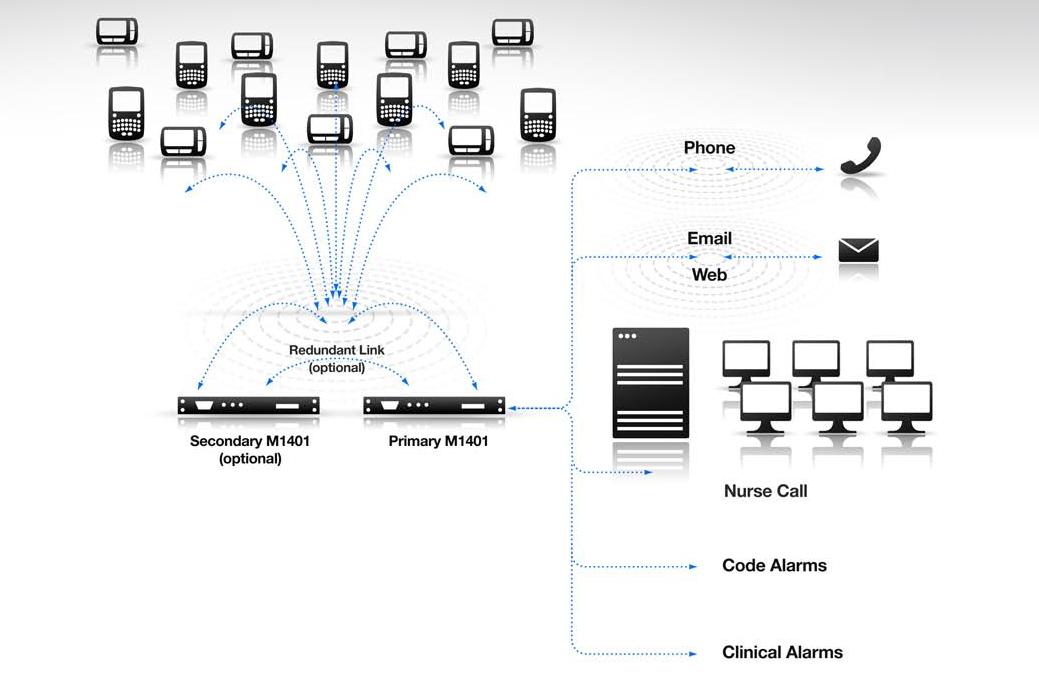
The Critical Response System consists of a centrally-located M4101 system controller and roof-mounted base antenna, providing coverage to an entire hospital complex and up to 20 additional square miles of surrounding area. The M4101 connects directly to nursecall systems, HL7 alarm managers, bedside alarm systems, patient care devices, E-MAIL systems, and other hospital communications systems. With the optional Access Gateway, authenticated users may also connect with a web browser. Users send messages to the system, which instantly relays the messages through the base antenna to individual recipients or groups of recipients. The system then collects responses through the base antenna and relays them back to the sender. Doctors, clinical personnel, and automated systems send messages and receive live responses, and all messaging and response activity is stored for long term analysis